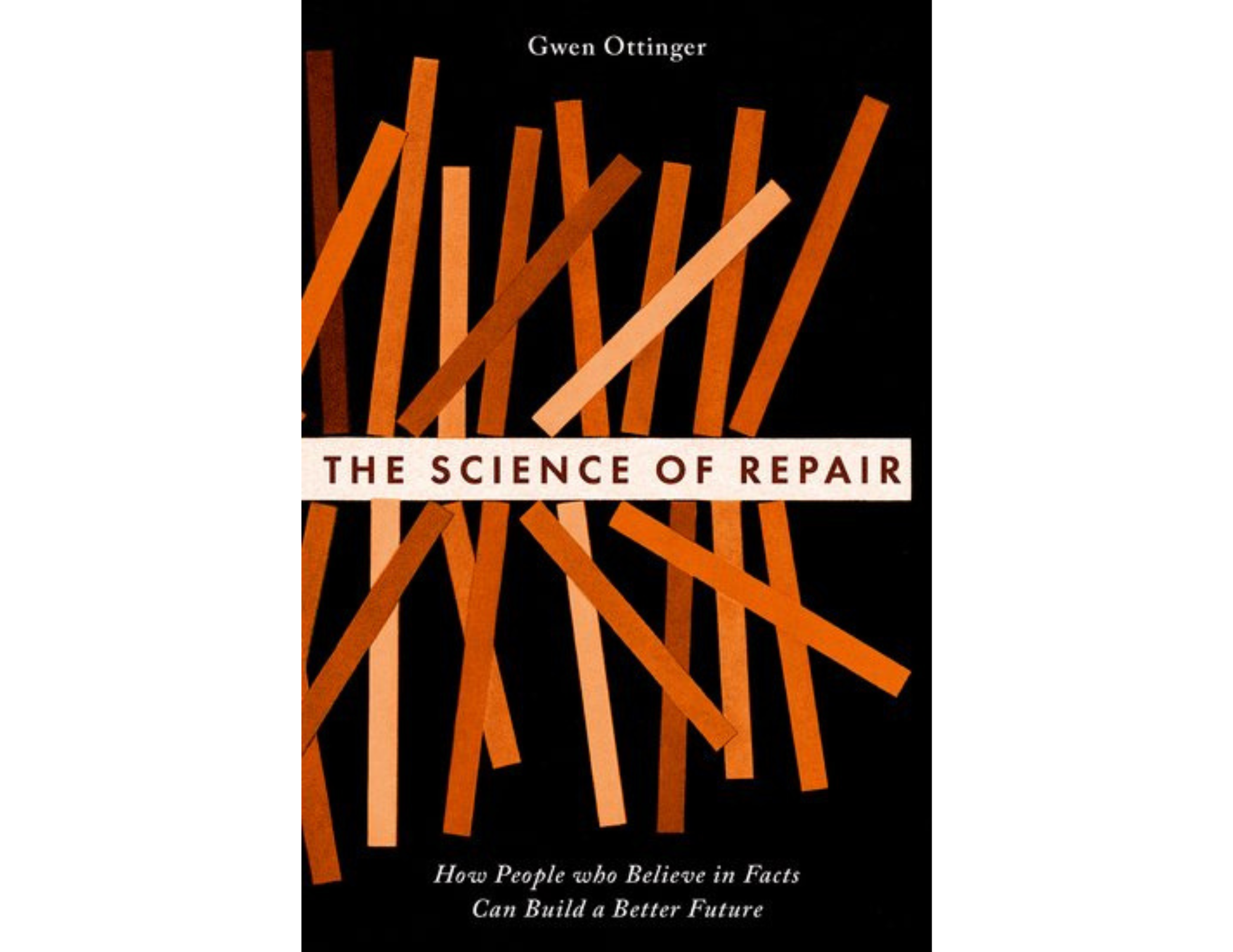
How does our perception of science reflect how we value our fellow human beings? Who is worth defending, why, and how do we go about doing so effectively? In her latest book, The Science of Repair: How People Who Believe in Facts Can Build a Better Future, Dr. Gwen Ottinger takes her personal experiences with studies of environmental monitoring and translates them into an expansive philosophical inquiry into knowledge, responsibility, and the quiet, structural violence embedded in society. This book will transform the way you think about science, morality, and how power controls society.
Ottinger begins her exploration with a series of crises: a long history of communities across the country defending themselves against polluting petrochemical corporations—as much from actual environmental pollution as from more symbolic forms of violence. In 2012, a gas-leak-turned-fire at a Chevron oil refinery in California resulted in a cloud of smoke that hospitalized thousands. In 2019, three explosions and a fire that burned for over 24 hours rocked local communities at the Philadelphia Energy Solutions refinery, which locals reported had been polluting the air and negatively impacting their health for generations. These are two of the many environmental and moral injustices she describes and analyzes to authenticate her main argument: that science can, and should, be used as a tool to repair moral relations and contest injustice. She describes moral relations as “widely accepted ideas about right and wrong” that determine who is protected, who is believed, and how wrongdoers are held accountable. Societies with strong moral relations use established institutions and social norms to stand up for each other when faced with injustice. In societies like the one we currently operate in, reparative science is necessary to rebuild and uphold those ideal moral relations. Reparative science describes a way to practice science that moves beyond prioritizing the production of data and facts to focus on repairing these moral relations.
A key obstacle to the recognition and validation of reparative science is what Ottinger calls scientific chauvinism, an attitude and social norm that, she writes, “awards the moral high ground to people with formal credentials in science related disciplines.” Traditionally, we might assume that the merit of the title of ‘scientist’ itself should be enough to elevate an individual or institution’s legitimacy. This is a slippery slope for many reasons. The issue lies not necessarily in the value placed in credentialed scientists, but the lack of value afforded to an ignored class of researchers known as citizen scientists: so-called ‘ordinary civilians’ who take it upon themselves to collect data and form facts based on their own experiences and research, often without the support or protection of official institutions and the general public alike. This is an idea highlighted in the distinction Ottinger makes between “really science” and “knowing well”—the difference between awarding validity and power to researchers on the basis of official title over the epistemic worth of the research and the lived experiences of the researchers themselves.
Throughout the book, Ottinger situates these ideas about our perception of science and morality within the broader reality that communities facing environmental harm are often overlooked, ignored, and blamed for their own conditions. Data collection and the production of facts are certainly valid and necessary functions of science, but reparative science does that in addition to upholding standards of accountability and rebuilding moral relations. The problem is not simply what we know, but how we decide what counts as worth knowing and whose knowledge is allowed to matter.
What makes The Science of Repair particularly compelling is its refusal to offer simple solutions. Instead, it holds an insistent commitment to inquiry in a way that becomes a type of resistance itself. Ottinger writes, “Science, as an enterprise, needs to be involved in holding space for debate over the content of our moral standards, by promoting the invariable aspects of functional moral relations while remaining agnostic about contested standards.” In a world where facts can be dismissed and harms ignored, the act of continuing to ask, to listen, and to investigate takes on moral significance. Science is imbued with the practice of morality just as much as anything else is. Reparative science reconstructs our notion of it into a practice that can foster accountability and inclusion even when it cannot deliver certainty.
The Science of Repair is timely and necessary for scientists and knowers across all fields. In a culture rife with polarization and the normalization of suffering and injustice, Ottinger offers a vision of inquiry that is both revolutionary and attainable. By recognizing science’s inseparability from moral worth, this book challenges readers to reconsider not only how knowledge is produced, but what it is for.
You can purchase a copy of The Science of Repair: How People who Believe in Facts Can Build a Better Future here.
The Science of Repair: How People who Believe in Facts Can Build a Better Future
Gwen Ottinger
Oxford University Press
March 2, 2026
208 pages

Micah Allen is a fourth-year student at Drexel currently pursuing a BA in Philosophy with a concentration in ethical theory and practice. In addition, she has minors in Sociology and Linguistics. Her favorite genres include science fiction, psychological horror, and historical nonfiction.