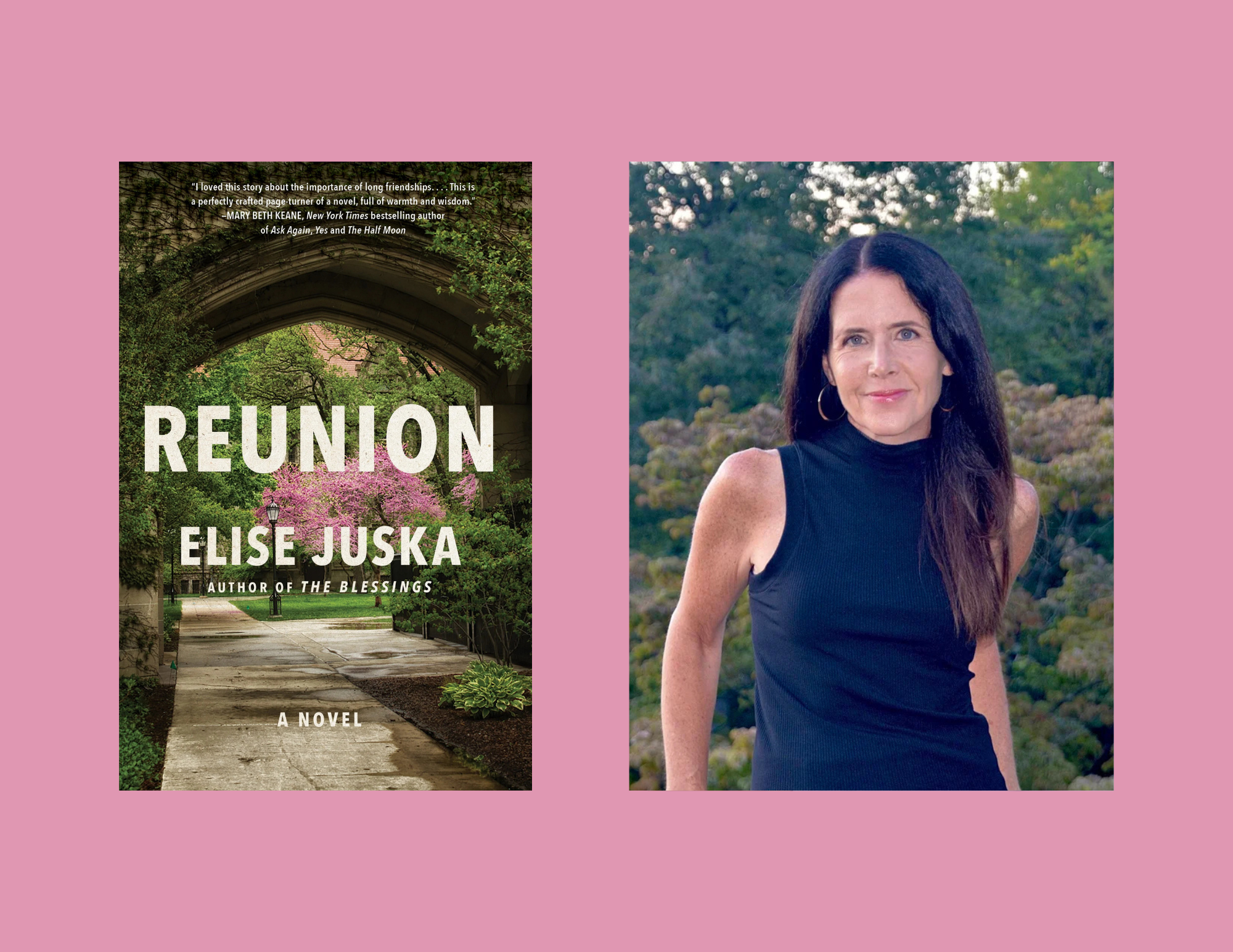
Elise Juska is an award-winning novelist and short story writer from the Philadelphia area. Her novels include Reunion, If We Had Known, and The Blessings, which was a Barnes & Noble Discover pick and named one of the “Best New Books” by People Magazine. Her writing has earned her the Alice Hoffman Prize for Fiction and has appeared in Ploughshares, The Missouri Review and The Gettysburg Review. A graduate of Bowdoin College and the University of New Hampshire, she currently teaches creative writing at Haverford College and Drexel University.
Itzel Sosa: As a starting point, can you tell us a little bit about where your writing is right now?
Elise Juska: Well, my most recent novel, Reunion, came out in 2024 and was released in paperback this past May. Right now, I’m working on my next novel. It takes me roughly three years to write a novel, and I am in one of the most pleasurable parts of the process. I know all the characters; I know the story and what’s going to happen. It’s just a matter of getting it all out on the page and refining it. But I’d say there was a point a year ago that felt more unsettling. When I go into a novel I have no plan—that’s part of the fun of it, the discovery, the process of getting to know the characters, the story—but there is a part in the middle that can feel disorienting, where inevitably I’m not sure where the story is going and I’m worried it’s not all going to cohere. Now I’m in that later stretch where I’m sort of living with these people, which sounds weird because they’re fictional characters, but these are the people I spend every day with. I know who they are and how they would react in a given situation. That’s a really fun place to be. I’m teaching a fiction workshop at Haverford College on Tuesdays, so I’m teaching-focused in the beginning of my week and then I spend the rest of the week on writing.
IS: Since we’re on the topic of teaching, what made you want to become a professor?
EJ: I love to talk about teaching, in part because I just love teaching, and because it is really connected to my writing. I feel fortunate that for me, going into a room of undergraduates talking about fiction writing is just energizing. It makes me want to dive back into my own work. Looking back, I can see who I was as a kid in who I am as an adult. I was very shy. I wrote in my room all the time, and if I wasn’t writing in my room, I had an imaginary class. I had made up all these students; I still have my class lists. We had a little chalkboard hanging in my living room, and I would stand there “teaching.” Those were the two main things I did as a kid and those are the two things that I’ve ended up doing in my professional life: writing stories and teaching students.
I grew up outside Philadelphia and went to college in Maine, at Bowdoin. Then I went directly to grad school where I started teaching freshmen for a first-year writing course. With the exception of one year, where I worked for a magazine, I’ve just been teaching ever since. The teaching and the writing have really always gone hand in hand.
Here in Philadelphia, I spent the bulk of my teaching career at the University of the Arts. I was there for 24 years; when I was first hired, we had no fiction writing. I taught first-year writing. Then I was offered one fiction writing workshop. Over the years, I helped develop a creative writing minor and then a major so eventually we had students enrolling for creative writing, which was super exciting. It was a really vibrant culture. In 2024, faculty received one week’s notice that the school was closing, which was devastating. Though I still miss it, I’m glad to have started teaching the fall residency at Drexel’s low residency MFA program; it’s been a wonderful experience.
IS: Tell me a little bit about your background in Philly. How has living in the city and around the city influenced your writing?
EJ: A lot of my stories are set in Philly or around Philly. It’s interesting. I went to college in Maine and then to graduate school in New Hampshire. I found that once I wasn’t living here, virtually everything I was writing was set here. Sometimes when you have a little distance from a place, you can see it more clearly. A specific neighborhood that I’m always drawn back to is northeast Philly, where my cousins lived. As I said, I was a really shy kid; I found their neighborhood intimidating. The kids seemed so much more worldly than I was. When I think back on my childhood, this is the place my mind goes. My favorite of my novels is called The Blessings, which is about a big Irish-Catholic clan in Philadelphia, last name Blessing, which is some ways similar to my own.
In addition to being a rich setting for fiction, I find Philly a wonderful place to be a writer.
There are a lot of writers living in Philly these days, which wasn’t always the case. Earlier in my career, I made connections with writers who then moved on to New York. There was almost a feeling that you needed to move to New York, but that no longer feels true. There are many incredible writers living in Philly, in a vibrant writing community. That’s definitely been an influence on my writing life too.
IS: Why do you think more writers are staying in and moving to the Philly area?
EJ: There’s something about the writing community in Philly that feels incredibly supportive instead of competitive. Philly is an accessible place to live, and it’s not hard to find writing communities that are welcoming and inclusive. There’s also a vibrant book culture, with many terrific independent bookstores. I recently did events at the wonderful Mavey Books in Ardmore and Capricorn Books in Jenkintown.
IS: Do your own relationships inspire the relationships in your novels?
EJ: I think inevitably that happens; there’s probably a way that every character reflects some part of me or something from my own life. When I was in graduate school, I was writing things that felt more directly autobiographical. I wrote in the first person almost always. I was pretty young at the time; I think I just had to get my own stories out of the way before I could go on to write things that were more truly fictional. Now I write everything in the third person; I think that signals some growing distance between myself and whatever I’m writing. The Blessings was not directly autobiographical but certainly inspired by family dynamics. My second novel, If We Had Known, is about a teacher; no doubt all my years of teaching influenced that book. My most recent book, Reunion, is about three friends going back to a pandemic-delayed college reunion up in Maine, which is something that happened to me—my reunion was canceled during 2020, though it wasn’t actually rescheduled. What happens in the book is, in some ways, me imagining what it would be like to go back.
IS: Did you ever take inspiration from the stories you wrote in college or grammar school for a recent novel?
EJ: There are many drafts of stories that never totally cohered or I never published. I think that’s true of any writer and, as I tell my students, there’s no wasted work—all of those drafts helped me to write the stories that eventually did get published. Even though they took up time and energy, they were all part of the process of learning to be a writer. With The Blessings, for example—I had been trying to write that story, of a big Northeast Philadelphia family, for years and years. In college, graduate school. I wanted to write about my own family but I didn’t know what I wanted to say, and I was maybe too close to it or too young at the time. It took me time to grow as a writer and a person to figure out how to tell that story.
IS: Which out of the three novels was the most difficult for you to write?
EJ: The hardest hands-down was If We Had Known, the story about the teacher. The story is about a teacher who realizes, after a shooting occurs in her town, that the gunman was a former student of hers. She begins to question whether he had written a paper for her class that contained red flags that she just hadn’t noticed or dismissed too quickly. Writing and researching that material was really difficult and having to live in that story was uncomfortable and scary. For me as a teacher, that’s a great fear. As a young teacher, I taught a first-year writing class in which my students would often write about things that were really personal. I had a responsibility as a teacher to ensure that there wasn’t something in their writing that I needed to be worried about, to ensure their writing wasn’t coming from a place that was troubling. Not that I ever worried that any of my students were violent. But there’s a kind of worry, a vigilance, that I think teachers—and maybe particularly writing teachers—carry around.
IS: Do you have any advice for aspiring writers?
EJ: I’ve been where you are. I know the frustration of spending a lot of time on a story or even a novel that doesn’t ultimately work. But I do think that there’s value in all of that work. It’s all practice for the next thing. It helps us write the next story, the next novel, that really does come together. Again, it can feel exasperating when you just want to get things finished and out there into the world. But take time to ensure the story is taken as far as you can take it. Try not to think about the publishing part. If you think too much about it, it can get in your head. It can compromise the story. It’s important to have patience.
You can learn more about Elise Juska’s books, upcoming events, and recent news at her website.

Itzel Sosa is a graduating senior earning her BA in English with a writing concentration and minor in Law as well as a certificate in creative writing and publishing. When she isn’t at school or studying, she enjoys cozying up with a book and exploring Philadelphia. After graduation she plans on attending law school.