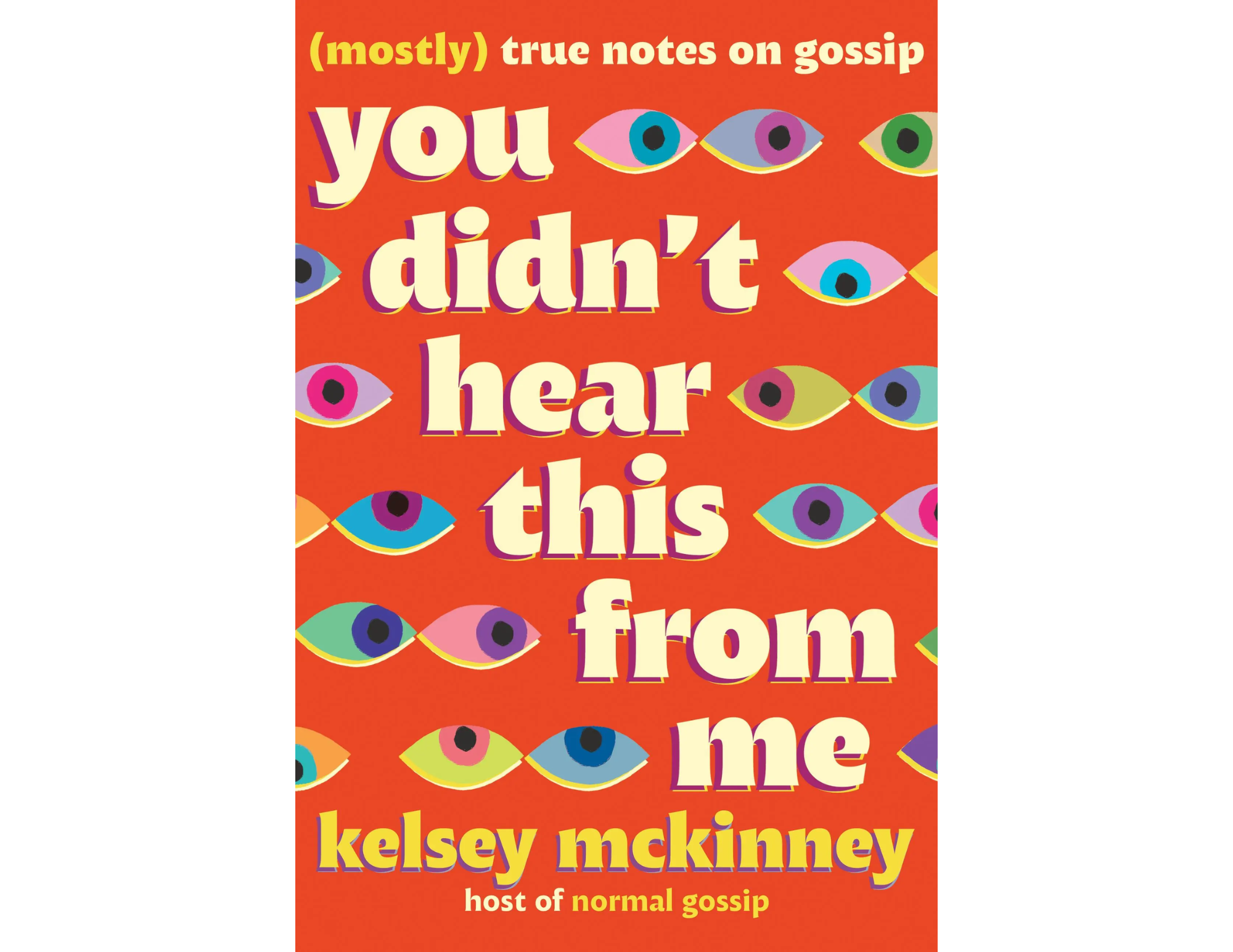
Kelsey McKinney’s You Didn’t Hear This From Me is a witty and deeply confessional compilation of essays bound to change the minds of gossip-hating readers. Her collection challenges society’s demonization of gossip through sharing her personal beliefs and experiences, cultural criticisms, and journalistic and scholarly research. McKinney reframes gossip as a tool for survival and a complex form of storytelling rather than just “women talk.” She claims that gossip is a way for people excluded from power to stay informed despite institutionally privileged people’s tendency to gatekeep knowledge. At the same time, she addresses how gossip can be weaponized to harm others. Throughout the book, McKinney presents a deep dive that proves to readers that gossip is a crucial function of society, especially in the way it helps us navigate communities.
“At its most basic,” McKinney writes, “gossip is just one person talking to another about someone who isn’t present.” She shares that discussing major league sports trade deals, doctors analyzing an x-ray together, and sharing Taylor Swift’s Instagram posts with a friend are all forms of gossip. On the flip side, she also defines what most people identify it as: “We also say ‘gossip’ when we mean slander, libel, or hate speech. We call celebrity news, calls from our mom, and whisper networks gossip. Even in scientific research, there is no consensus on what ‘gossip’ means. We say we love to gossip, and in the same breath we say that gossip is dangerous.” Her research and thoughts run deep into human interaction and communication, stating that early humans survived by gossiping; they communicated which individuals should be the hunters and who should be the gathers based off their skills. She also references Robin Dunbar’s Grooming, Gossip and the Evolution of Language, and cites his argument that “conversation serves the same function as grooming in the animal kingdom.” McKinney analogizes that teenage girls leaning over to tell a secret or a coworker sharing important information is similar to chimpanzees picking bugs out of each other’s hair—all these instances “signify closeness and allyship to others in their community.”
McKinney has always had a passion for gossip, even when she grew up Evangelical. She notes that her love for gossip was criticized by her church. She was told that it would ruin her life if she let it consume her. But young McKinney couldn’t compromise; she needed to gossip. From an early age she saw gossip as a tool to discover information that could protect herself and those around her. As an adult, she claims that gossip has a bad rap in Christianity because there is some truth to it, and it can easily hold those in power accountable. McKinney writes, “[Gossip] fights against secrecy, and while that can be dangerous when used against people without power, it targets anyone in leadership of any church who has an immense amount of power.” Confrontation and quarreling, which the church bitterly claims is fueled by gossip, is necessary in the battle against abuse and repression.
McKinney also discusses the negative effects of gossip within modern society, especially through the anonymity associated with being online. On one hand, marginalized people have used this anonymity as a tool to be able to speak about someone with more power than them with a lessened concern of retaliation. On the other hand, she highlights the use of anonymous online platforms, like Deuxmoi (an online blog that rose to popularity by posting anonymized celebrity gossip) and subreddits like r/AmITheAsshole and r/relationship_advice, to spread lies. She notes that people are particularly gullible when reading something removed from context, such as reddit stories reposted to other platforms. McKinney also mentions both how gossip affects the lives of the people it’s about, from examples of large media companies like TMZ invading and destroying the lives of celebrities like Britney Spears and, in more personal anecdotes, about how friends have unintentionally betrayed her by telling her gossip to others.
McKinney doesn’t argue there is no harm in gossip—she knows it exists. Instead, she sits with the discomfort of its harm and acknowledges that people gossiping do not mean to hurt others, but to protect themselves. As she reflects on why gossiping is so important to her, McKinney writes, “I’ve realized that what I am actually looking for when I gossip is pleasure—and community.” She proclaims again that, despite its ability to be weaponized, gossip is a necessary way to interact with our communities, because without it we would be unable to inch closer towards understanding the many truths about ourselves.
You can learn more about Kelsey McKinney and her book here.
You Didn’t Hear This From Me: (Mostly) True Notes on Gossip
Kelsey McKinney
Grand Central Publishing
February 11, 2025
288 pages

Tori Harrigan is a fifth year at Drexel pursuing a BA in English and a concentration in writing. Alongside her studies throughout her college career, Tori was a Sports Editor at The Triangle, Drexel’s independent, student-run newspaper, and became Drexel Ski Team’s Freestyle Captain and USCSA’s Atlantic Highlands Conference Women’s Snowboard Freestyle Champion in 2025. In her free time, she loves cooking while listening to music, watching anime, and catching up with family and friends.