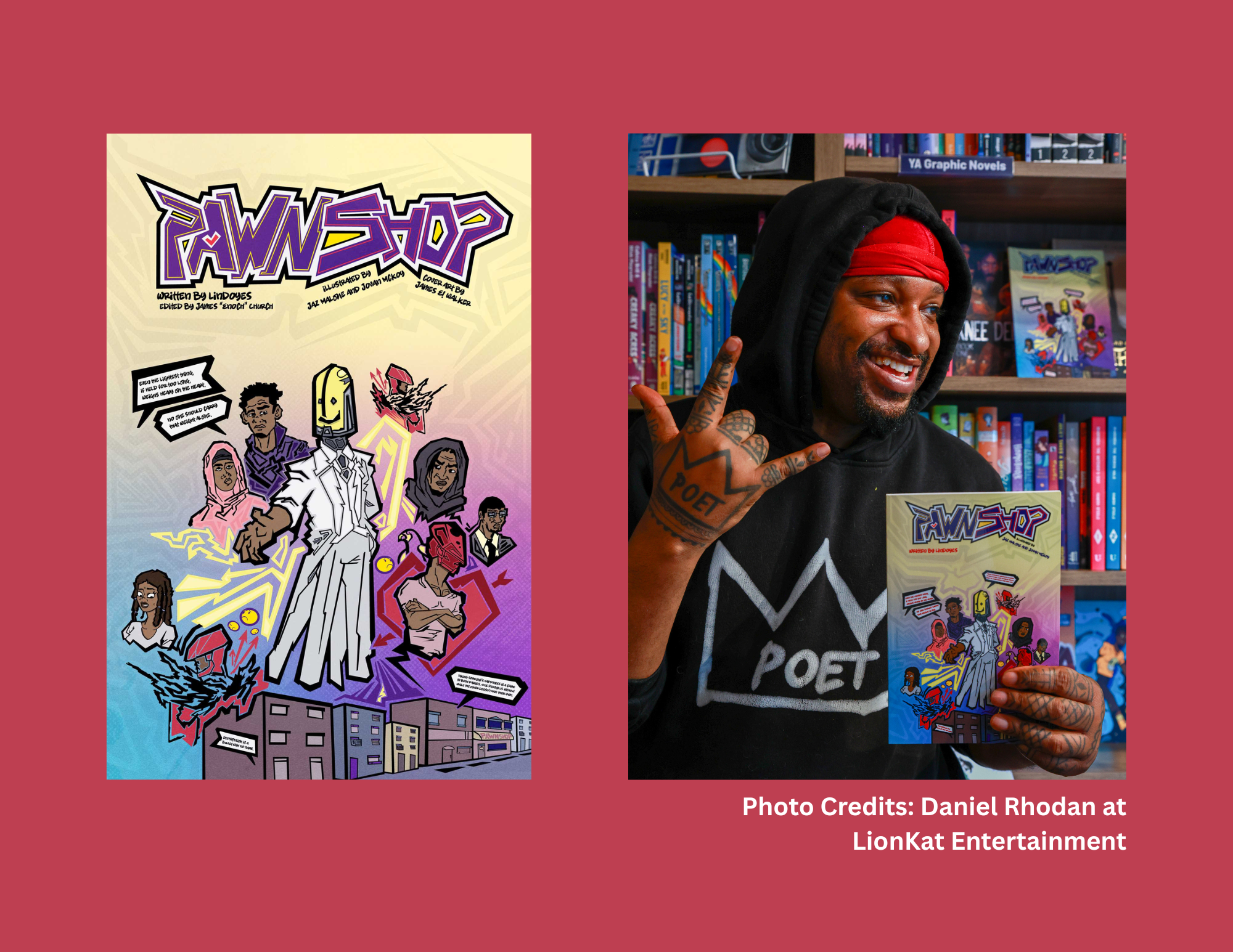
LindoYes was born and raised in Germantown, PA. He is primarily a spoken-word artist but has recently published a graphic novel titled Pawnshop. His work focuses on political issues such as general healthcare with a highlight on mental health, race inequality, emotional regulation, and public safety. Along with writing, he teaches poetry to students in Philadelphia.
Tiffany Cracraft: How does your viewpoint on reading and writing influence your own work?
LindoYes: Taking on a profession where I must do a lot of reading and writing as well as performing, I often think about how the literary world can be more accessible to me and how that world has already been accessible to me. That has always been comic books. And, when I’m performing, I’m often thinking about how I am narrating a story for someone else more than I am thinking about the words on the page.
So, for me, I’m already seeing the images and then I’m just speaking out the words that go into the images. So, graphic novels just felt like a good fit to put my poetry in, to tell a story, because I was seeing all the images in my head already. When it came down to it, it felt like my right hand is my dominant hand, which would be poetry and performances, and then putting the images to words was my left hand, so putting the graphic novel together just felt very organic because of my learning disability, as well as because of my profession.
TC: How does your dyslexia play into your writing?
LY: It plays into my writing because I am often trying to pair the worlds of images and words together. And I’m also trying to, for lack of a better saying, make it not just accessible for people that are dyslexic like me, but accessible to people that want to pick up a book but find all the text on the pages overwhelming. Maybe you’re not a reader, but the images make it more accessible, because they’re saying a thousand words that go with what you see on the page—that makes it feel like a lighter weight, but still as heavy as reading a book full of text. So, for me, it makes sense and that’s why I’m doing graphic novels.
TC: What inspired you to create Pawnshop with the themes that it has?
LY: I want universal healthcare in our lifetime, and sometimes, to achieve something that seems like it is not attainable, you must write fiction. The first time I saw someone talking to their watch was in a Power Ranger show, and now it is as normal as everything else. At the time, it seemed so far-fetched. People talking to their watch, like you would a phone. Now it’s done. So, I think, I want this politics, this policy that I think is very much needed to be approachable, to be understood, and therefore it can be achievable.
Another part of it is I had a really bad date—more so on my part, where I wasn’t just leaving a good impression of myself and I knew the date wouldn’t lead to a second date—but my date had said to me that “we’re all in this world, trying to lessen our collateral damage on others.” And that just stuck with me, and I sat with that idea for a minute, and then, I said, “Yeah, that’s kind of how pawnshops work.” They lessen the emergency in your life when you’re pawning off something to get that upward mobility, to pay off that bill, to cover those expenses. That’s how pawnshops are working. I said, “Yeah, that’s great.”
I had two poems at the time that I felt worked well together, talking about mental health. I already saw the characters in my head because I was acting them out in my poems. So those were the inspirations behind the writing aspect of it—life experience and policies I want to see changed; my performance and professional life led me to meeting Row House. They offered me an opportunity to create a comic book, and I was like, alright, I gotta do it.
Everything Before Us is a sci-fi movie I was inspired by. Emotional credit scores were publicly displayed, and they held people accountable for their past relationships. If you got in a bad breakup, or you’ve ever been in a divorce, or anything, that may lead to you not getting employed somewhere because your emotional credit score is not good. “You weren’t even stable in your last relationship. I don’t think you’re gonna be stable at this job.” So that was such a beautiful movie that just stuck with me, and I pulled some inspiration from there.
TC: Do you have any thoughts on how writers can foster community development, in small or large ways?
LY: I think in small ways, we can talk to each other about how we’re getting paid, who’s paying us, and how they treated us when it comes to that payment. I think, within the poetry/spoken-word community in Philadelphia, we don’t have an official union, but we have unity amongst each other. Meaning that when we talk about our wages, because there is a wage gap, it helps us to advocate for each other and make sure that we’re being paid fairly and have good working conditions.
Another thing is that, in Philadelphia, most people have to travel miles to go to the nearest grocery store. That leads to people having to plan their whole day around grocery shopping, therefore they don’t get the rest and relaxation that helps them with their mental health, or it leads to unhealthy eating habits because of them being so far away. But with the community fridges, carpooling, and food deliveries, we are looking out for each other. So that’s something we could make available across Pennsylvania. Other states have state stores where people could do grocery shopping that’s paid for by their tax dollars. We could have four state stores in North Philly that will make it easier to get the food you need at prices that you need.
TC: Is there a scene, passage, or poem in the book that you’re proud of?
LY: There are pages where we—and when I say we, I’m talking about Jaz and Javon, who are the illustrators of Pawnshop—did something to the layout of the panels to make it an image itself, to convey a message. I like to refer to them as impact pages. So, there’s one where there’s a semicolon on a page where we’re talking deeply about depression and living with these heavy feelings that make you think of harming yourself. And there’s a page where we made the panel look like bubbles, and it’s talking about being gentle, how the world can be gentle. There’s another panel with a heart shape that has a character dealing with the idea of the conditions that we are in and how so much of this world is just pawning in emotions to each other. So, those pages really stand out to me, because I remember writing them and the process of illustrating them, and there was a lot of intention that the other pages didn’t get.
TC: Is there anything essential that you would want to preserve if your book were adapted to film or television?
LY: How Black it is, how Philly it is. How poetic it is. I wanted to showcase Philly, and not in the sense of landmarks like the Art Museum steps, the LOVE statue, the Rocky statue. I think so many people think of Philly, and they think of all these things that are around City Hall, but really Philly, it’s just row homes and corner stores. I want to show the people that sit on a porch, and they’re staring with wonder, but they’re not lost. I want to show that the majority of Philly is Black. I also want to keep it true to the poems I put into it because Philly has a big poetry community. These should all be stenciled to any format it is adapted to, but you can pretty much do anything else with it. If you don’t get these elements right, it ain’t mine. Don’t even put my name on that.
LindoYes’s book Pawnshop is available from Simon & Schuster. His website features merch for Pawnshop, more information about his creative works, and links to his social media pages.

Tiffany Cracraft is a Drexel senior who is majoring in psychology and minoring in animation and visual effects as well as writing. She loves discussing complex topics within the writing community and bringing attention to her audience through her articles. Outside of her academics she enjoys playing board games with her friends, caring for her dog, engaging in disability research, and going to her local café to relax or get work done. After graduation she plans to pursue clinical or research psychology and work in the animation industry.