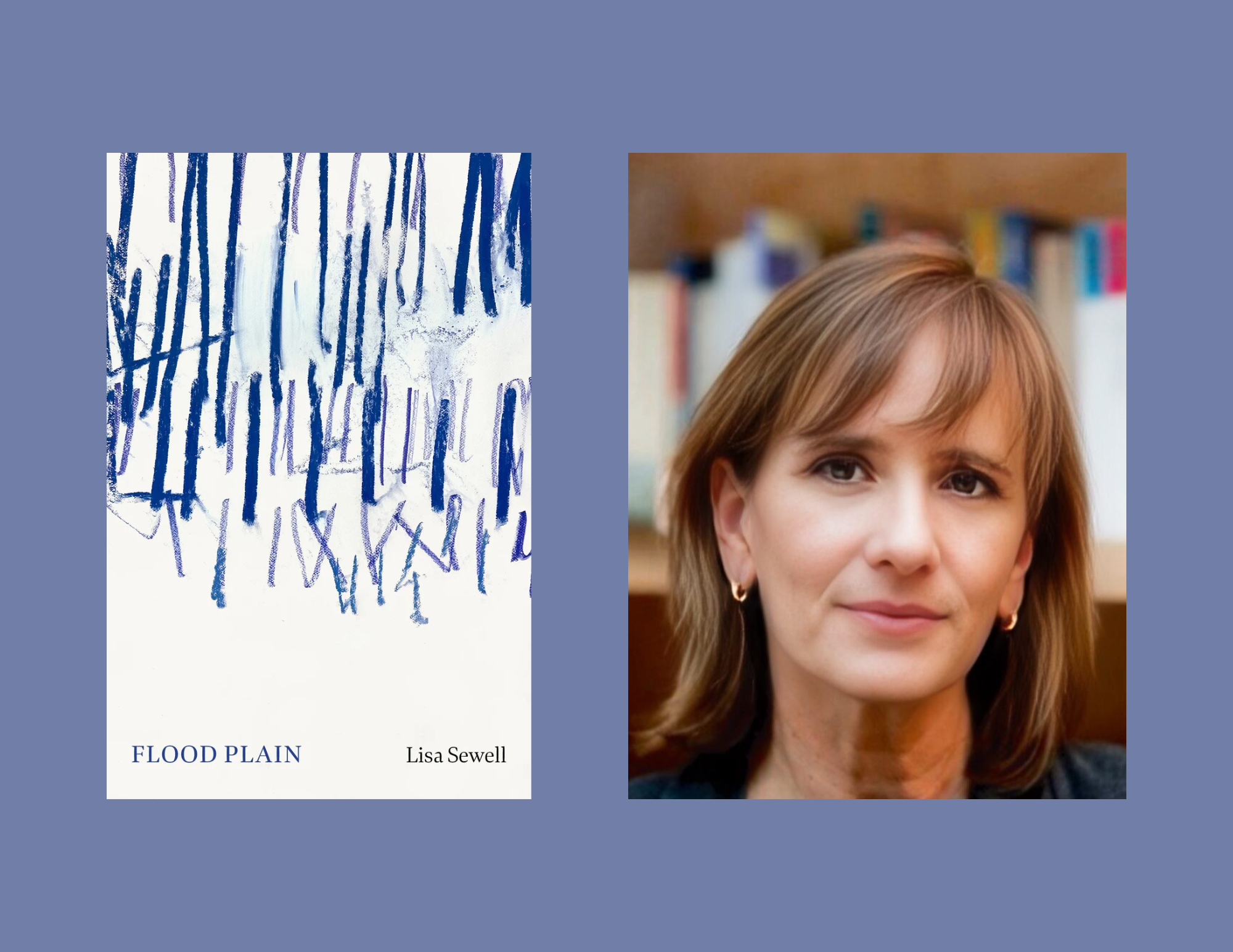
Lisa Sewell is a Philadelphia-based poet and English professor at Villanova University with a background in marine biology. Her poetry often explores themes of species extinction, climate activism, and social justice. Her newest poetry book, Flood Plain, is a meditation on her experiences in nature, the destruction of our planet, and grief.
Evan Redl: Many poems in Flood Plain center around environmental themes; they’re deeply personal yet grounded in historical and scientific research about ecosystems and animals. How do you balance research with personal reflection when drafting poems? Which do you focus on first?
Lisa Sewell: It depends on the poem. For example, I started working on the poems in Flood Plain about endangered and extinct species when I went to a show called “Animalia rarissima” by Philadelphia artist Susan Hagen, which featured a series of wooden sculptures of endangered species. I was profoundly moved by the show, so I got the list of species from the show and started researching them. For those poems, I started with research, but I also had some background in animal physiology that I could draw on; my undergraduate degree is genetics and marine biology. I enjoyed learning about the physiology of the whooping crane, and the life cycle of the green sea turtle. I also researched cultural myths around animals, from Native belief systems to Western ideas. For the grizzly bear poem, I read a whole book of accounts of people who had survived or witnessed grizzly bear attacks. But I also had to find my own connection to the different endangered animals in order for the poems to work.
There are also a number of place-based poems in the book that drew on both first person experience and research. A sequence of poems about the Colorado river came partly out of my own experience on river trips through the Grand Canyon, but I did some research, too. I learned about the ways the Colorado has been devastated by the construction of the Glen Canyon and Hoover dams and about John Wesley Powell’s expeditions on the Colorado. For a lot of the poems in this book, the research came first and that was new. In the past, I mostly depended on inspiration. These poems were more planned. I had an idea of what I wanted to write about, and set out to learn about it.
ER: For the poems in Flood Plain that draw on specific places you’ve visited, do you take notes while you’re there, or do you prefer to write later from memory?
LS: It depends. Sometimes I would take notes; if there were informational signs about an area, like the Salmon River estuary in Oregon, I’d take photos or write them down. I spent three months at the Sitka Center for Art and Ecology, which is on the coast of Oregon, and I walked a lot while I was there. After a walk, I would make notes about everything I had encountered, and then I would start learning about it. During a walk, I might take notes about a bird I saw flying overhead, and when I got home I would try to figure out the species and learn more about it. For the series of poems about the estuary, I was inspired by poets who have a daily writing practice, and I tried to walk every day and write every day. But I wasn’t writing on foot. It was too rainy to even do that on the Oregon coast. When I was kayaking along the Colorado river in the Grand Canyon, I would take notes at the end of the day. I tried to remember what happened and, though pretty exhausted, I would try to write it down and then use that as the basis of the poems.
ER: When did you first come across Maria Sybilla Merian? What about her story inspired you to include poems based on her illustrations in Flood Plain?
LS: When I look back, it’s amazing how much of my work comes out of the wonderful artist residency opportunities I’ve had. I was invited to a residency in Virginia at Oak Spring Garden Foundation, the former estate of Paul and Bunny Mellon. It was a two-week residency with a focus on their library, which includes many first editions by 18th and 19th century naturalists. Four or five different scholars and environmental artists came and gave talks. One was Kay Etheridge, a biologist at Gettysburg College who was writing a book that focused on Maria Sibylla Merian as a scientist. Etheridge explained that Merian was one of the few women naturalists at the time; there were more in the 19th century but very few in the 18th century. I was intrigued and decided to learn more about her and write about the beautiful prints that were part of the library collection. She is a fascinating figure. As a child, she studied and drew caterpillars and butterflies, and she continued to be charmed by them throughout her life. At the time, people still believed in spontaneous generation. They didn’t know that caterpillars turned into moths and butterflies; they thought they grew out of meat or the laundry. She wasn’t the first person to discover that caterpillars metamorphose into moths and butterflies, but she was one of the first to describe that cycle in her art. She’s interesting as well because she was so determined to pursue her craft despite gender barriers. In Europe in the 18th century, women could be illustrators but not artists. There were artist guilds and women weren’t allowed to be in them. She’s fascinating for the way she negotiated patriarchy and was able to have a life and do work she was dedicated to. There were problems with her as well: she participated in the Dutch colonial project in Surinam. I tried to touch on that in those poems as well.
ER: Can you tell me about Birds of North America, your 2021 poetry collection? How did the collaborative process of working with a visual artist and another poet differ from the way you approached your previous works?
LS: That was a collaboration between me, the poet Nathalie Anderson, and the artist, Susan Hagen. During the pandemic, Susan did a series of miniature drawings of birds she saw in her backyard and on her walks in Wissahickon and Fairmont Parks. She wanted to make an artist’s book of the drawings to accompany a show at the Drawing Room gallery, and she contacted me and Nathalie and asked us if we wanted to contribute some poems to the book. Nathalie and I came up with the idea of collaborating on the poems. Instead of just writing on our own, we thought we’d write back and forth to each other. We found a poetic form, the rondelet, which is a short form that repeats the first, third, and seventh lines. When Nat sent me a poem, I would pick a line and make that the first line of my poem and then repeat it two more times. When I sent her my poem, she did the same thing. This created an exchange of sound and image throughout the book, a subtle echo between the poems—we wanted to imitate or evoke the way birds call back and forth to each other.
ER: Climate activism and feminism are common themes in your writing. Do you see poetry as a form of activism or as a space for reflection?
LS: That’s a good question. I feel like poetry can transgress boundaries and overturn hierarchies more readily than traditional novels or essays because of the way poems manipulate form. Because of this, poetry can be one place where there is resistance to traditional understandings of nature, especially a romantic understanding of nature where humans and nature are separate. The myth of that presumed separation can be overturned and the boundaries blurred, not just through content, but in the ways language is used and presented. I’ve learned a lot from poets like Brenda Hillman, Forrest Gander, and Brian Teare in terms of how you can write about nature and resist that indoctrination into the belief of a human/nature binary. As their work shows, poetry is a place where the interconnections between beings can be enacted as opposed to just written about, explained, or expressed.
On the other hand, that’s not why I want to write about someone like Maria Sibylla Merian, or about a whooping crane. I feel moved by my encounters with art and with the more-than-human world and that’s where my writing comes from: my own encounters with the world. I am equally interested in lyric expressiveness, which I think is clear in my previous books, but I have turned to ecopoetics in my writing because of what’s happening right now, with climate change and the loss of species that has happened in my lifetime. I feel really upset about it all the time. So I’d say both. I think poetry can change hearts and minds; it’s a place where things can actually happen and some kind of alternative can be expressed and enacted. It’s also the place where I can express my responses to the world, reflect, and maybe learn something from them.
ER: Some poems in Flood Plain allude to your experience teaching at a prison. How did that influence your writing? Did it change your perspective on the power of poetry?
LS: While I was working on poems in Flood Plain, I was teaching in a wonderful program run by Villanova where students from SCI Phoenix—a state penitentiary—can earn a BA from Villanova. I taught there every other year and ended up teaching about 10 courses all together—mostly poetry courses. It’s one of the most powerful experiences I’ve had as a teacher, and I am grateful to those students for all I learned from them. I didn’t want to exploit my students, but I wanted to write about my experience there. I see connections between incarcerated populations and species extinction. I feel like there’s a continuum between them. I did a book launch at the Free Library in Philadelphia, and two of my students from SCI Phoenix came to the reading. Quite a few of my former students are free now, but I’d had no idea that one of the people who came was free and out of prison. He was one of my most enthusiastic poetry students, so when I saw him and met his fiancé and learned that he had gotten his sentence overturned, I was moved beyond words. It’s impossible to describe how powerful it is to see somebody who you thought was going to spend the rest of their life in a DOC-issued uniform in their own clothes, living their own life, free. It was one of the highlights of my life.
You can learn more about Lisa Sewell and where to purchase her books through her website.

Evan Redl is a Marketing and Entertainment & Arts Management student at Drexel University. In his free time, he produces live shows, including open mics and comedy events. He also writes poetry and is a visual artist.