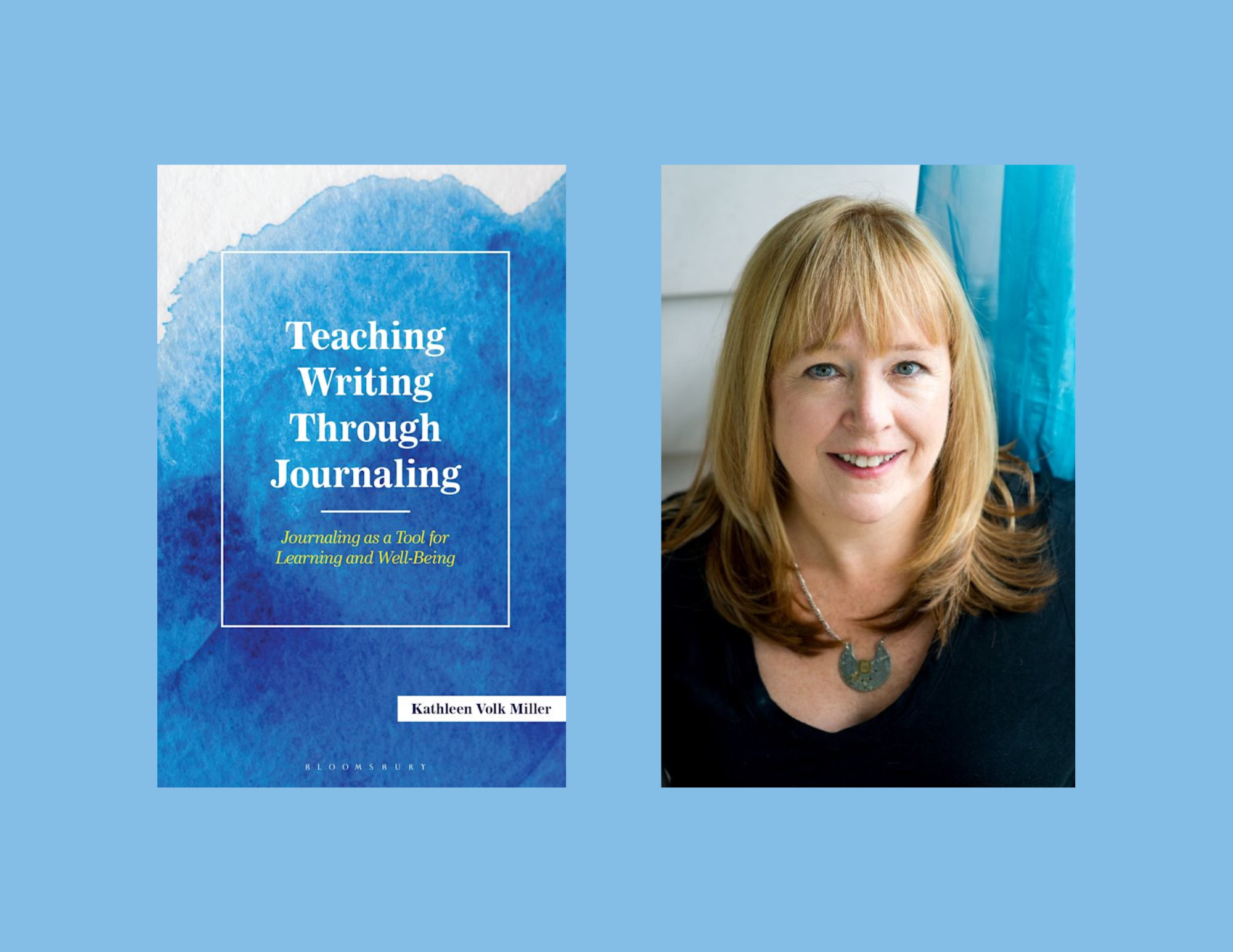
Kathleen Volk Miller is a writer who has been featured on Lit Hub, The New York Times, Oprah Daily, Salon, Huffington Post, Washington Post, Family Circle, Philadelphia Magazine and more. She is the co-editor of Painted Bride Quarterly (PBQ), a longstanding Philadelphia-based literary magazine, and the co-host of Slush Pile, PBQ‘s podcast. She is also a Teaching Professor at Drexel University, where she teaches English and writing courses. Most recently, her book, Teaching Writing Through Journaling, was published by Bloomsbury in late October.
Victoria Harrigan: You are very passionate about the connection between writing and cognitive function. Can you remember the first time this topic piqued your interest
Kathleen Volk Miller: I had a piece published in “Modern Love” in The New York Times, so that was a big deal for me, like probably my holy grail. It was about my children and I dealing with my husband’s death and the first time that I had to confront a situation that he would have managed and I would not have. That essay got me a ton of attention, and somebody wrote to me from the South Jersey Women’s Organization and said, “Could you come be the keynote speaker at our conference? We’ll pay you. And we would like you to talk about healing through writing.” It was such a big offer and such an honor. I agreed, but then I had to find out what healing through writing was. Prepping for that one speech introduced me to a rabbit hole that I just kept diving down. I’ve been a journaler my whole life, and the more science I kept finding behind it, the more enthusiastic I was to continue to research it.
COVID happened shortly after that, and a random library in Long Island, New York asked me—also because of the New York Times article—to lead a weekly journaling class on Zoom for their patrons. They were calling it “Journaling through the Pandemic” or “Journaling through Disaster.” I did that class for a year and a half. I ended up with a couple hundred pages of notes, because I just kept diving and diving and diving and diving and diving. And then right around that time, when that investigation seemed neverending, I said, “I’m going to do this as a theme for a Drexel class,” and I called it “Writing in the Brain.” I was very worried about how freshmen were going to take “you’re gonna journal every day.” They were disgruntled at the start. And then like three weeks in, they were the ones that wanted to tell me how much their life was changing. Then it became a 300-level course, Writing in the Brain. And then one day I was going through my 300 pages of exercise notes and I went, “I have a book. Oh my God, I have a book.”
VH: What is it about teaching writing and journaling that captures your attention?
KVM: I have always loved my job. This single course has made me feel even more like I’m making a real impact; I’m giving people something that they will take with them for the rest of their lives. I had a student not that long ago that got a raise and a promotion over cohorts that had been there much longer than her. And her boss told her, “It’s because you take notes in meetings.” And she said she wouldn’t have taken the notes in the meetings if she hadn’t had me talking to her about all the different ways that the act of writing makes things stay in your head, makes you think about things differently, makes you see things in a new way.
I also had a student who had me in 2020 and then asked me to write a recommendation for her medical school. I didn’t remember her, so I wrote her an honest letter saying, “I don’t remember you… let’s meet on Zoom.” Bottom line: she really believes gratitude journaling was life changing. She had done it for a couple of years. Life got big. She stopped gratitude journaling. Then she was studying for the MCATs and having a nervous breakdown. She was just really in a bad headspace and was trying to work up the courage to tell her parents it wasn’t going to happen. And her eye fell on her notebooks from when she was gratitude journaling and she went, “Oh, maybe I’ll try that again.” And she did, and it unlocked everything and made her feel better, and now she’s going to medical school. The reward for teaching this material is amazing, and I feel the difference.
VH: What was the writing and refining process like for you? Especially deciding what each chapter would focus on?
KVM: That was really hard. In the beginning of writing, I wasted maybe two months thinking, “I’m going to write what I know first. I’m going to do just gratitude journaling as one of the chapters.” But from reading, reading, reading all the time, I kept getting new ideas. I kept thinking, “maybe that would work for that, or maybe that,” but I kept just denying thinking about anything but the gratitude chapter. And I was just stymied all the time.
The minute I decided that I was allowed to have many, many buckets and just keep throwing information into whatever bucket, it helped so much. It was like a cork came off. Suddenly, everything I read fit in one bucket or another. And it helped me see my buckets. I was like, I need one just on handwriting, I want one chapter on young children, I certainly need a chapter on neurodiversity. As I was reading, I would go, “oh, there’s a concept I haven’t thought about yet.” Once I allowed myself to see it broadly like that instead of focusing on one chapter at a time, it worked much better. So, I wrote it all at once.
VH: Where did you find most of your research for your book? What do you think is the most compelling fact you’ve included?
KVM: Neuropsych journals, mostly. Neuropsych journals, and education people. Studying the brain itself is very big in the field of education because the brain is like the ocean: we know a lot about it, but there’s still a lot we don’t know, so it’s a whole area. Between neuropsych and education, the physiological changes from writing still flip me out. It’s almost like placebos. Like, so much stuff happens for real to the body with a placebo. So much stuff happens for real to the body with writing. Expressive writing helps you sleep better, helps with heart health. You have a higher immune system. These are all measurable markers. You could have a blood test and it shows it. There’s a part of your brain that they call the optimism trait. It’s a tiny little thing in your brain. If you expressively write or gratitude write for 30 days, it’s so much bigger, it can be seen with the naked eye on an MRI. So you are literally creating new neural pathways, changing your physical brain. You know, when I’m talking to people, I say, “you can’t change your eye color, can’t change your height… but you can change an actual part of your brain.” So the physical stuff is quite amazing.
The wildest study they ever did is they did something called a punch biopsy. They take a chunk of your skin out, which doesn’t heal for people for about 30 days. They had half the group expressive write in between. The other half did not. The people who wrote expressively were healed in two weeks. I don’t know if we’ll ever get to know why that happens, any of the physical things, but the healing stuff is mind-blowing.
VH: Did this book achieve all you hoped it would? Has publishing it inspired you to make any new goals?
KVM: I feel really, really, really great about the book. However, just recently, somebody who’s already using it, as an English teacher in a high school, said, “you know what? You really should have had another chapter on here for every subject, not just English, because the more I’m getting into this, the more I’m saying that this would help every topic.” My book is called Teaching Writing Through Journaling, but he said it should have been Teaching Journaling or Using Journaling in the Classroom because the subtitle is “Journaling as a Learning Tool.” He said this is not just for English teachers; every subject could benefit. I do regret that I didn’t add a chapter on journaling in other disciplines. So now I am in a quandary, and I have already written my editor about whether we wait three years for second edition, or if there’s some way to have an addendum that people could buy online. Do we just leave it? Do I write an article for an academic journal and hope?
A couple weeks after I signed the contract, they came back to me and said, “we’ve decided that we would like a writing series. Could you find other authors and do a whole series teaching on Writing Through Blank, Through Blank, Through Blank?” I said yes to that. And we already have Through Poetry, Through AI, For Neurodiversity, Through Media Literacy, Through Reimaginings, and Through Speech. Those are all in the queue and going to come out as part of my series, Teaching Writing. So that’s a big part of my future. I do feel really good about the book. My goal was to turn as many people as possible on to journaling. None of these theories are anything I’ve created myself; I’ve just put it all in a package for you and made it consumable.
You can learn more about Teaching Writing Through Journaling here.

Tori Harrigan is a fifth year at Drexel pursuing a BA in English and a concentration in writing. Alongside her studies throughout her college career, Tori was a Sports Editor at The Triangle, Drexel’s independent, student-run newspaper, and became Drexel Ski Team’s Freestyle Captain and USCSA’s Atlantic Highlands Conference Women’s Snowboard Freestyle Champion in 2025. In her free time, she loves cooking while listening to music, watching anime, and catching up with family and friends.