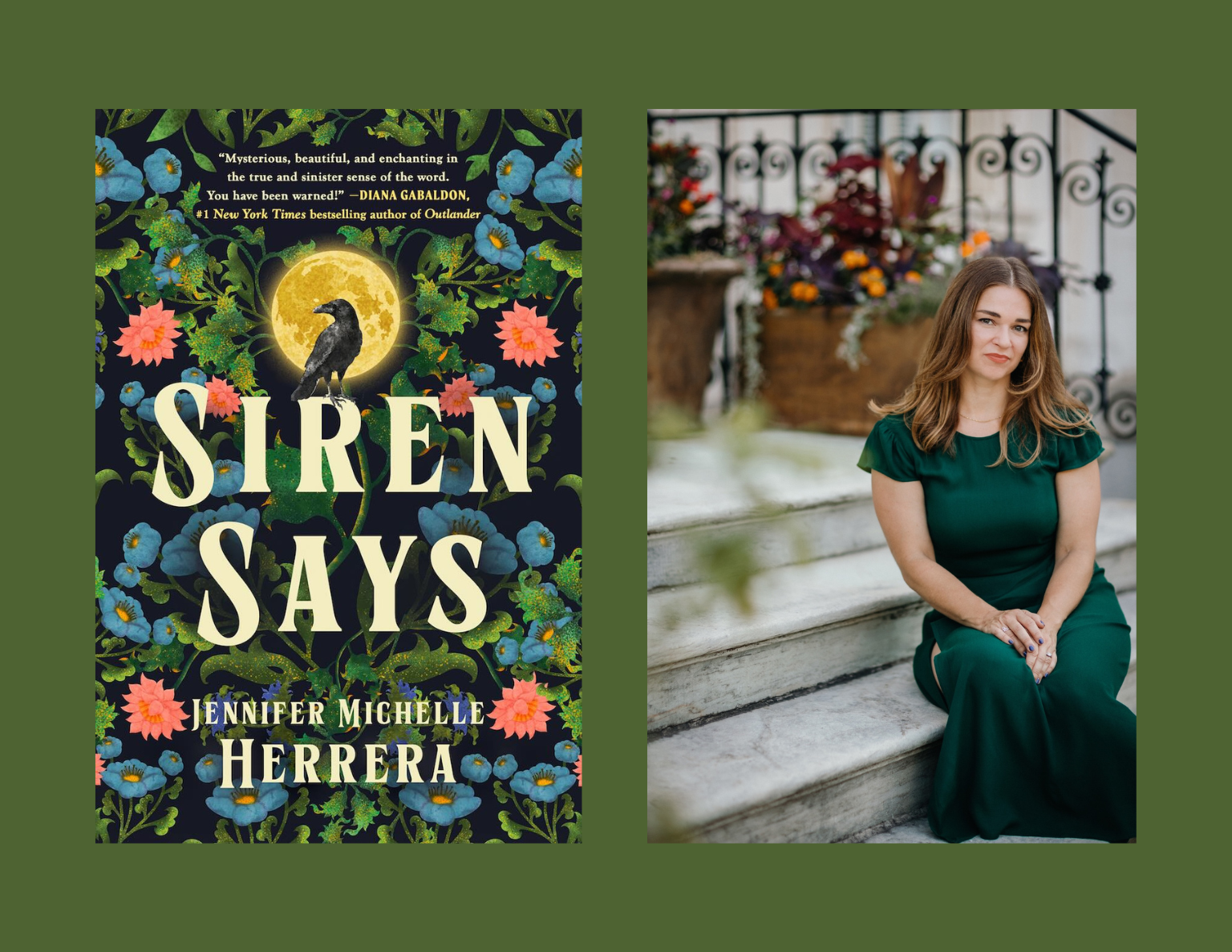
Jennifer Michelle Herrera is an author and literary agent currently living in Philadelphia. Her first novel, The Hunter, was published in January 2023. Her second, Siren Says, was published on August 18 of this year.
Azalea Feather: How did you get into writing novels?
Jennifer Michelle Herrera: I started out in academic philosophy, was on my way to getting a PhD, and I hated it. I didn’t feel like I fit in at all. So, I started writing fiction way back then, to manage my dissatisfaction with what was happening in my life. My first novel was called Ticking Bombshell—I still have a copy somewhere on one of my bookshelves. It didn’t go anywhere, but it taught me that I really like writing. At that point, I went to a writers’ conference, and I read something that I’d written out loud, and someone pulled me aside and said, “I love your writing, can you ghostwrite for me?” And that was really what started me off feeling like I could work in the publishing industry. I was always writing on the side, but nothing ever felt like it was good enough. I never felt like I had that thing.
AF: Has working in the publishing industry made writing more difficult?
JH: One of the problems with working in the industry is that you very quickly see how high the standard is for getting published. I could tell I wasn’t writing to that standard, so I did the next best thing and worked as an agent for a really long time. Then, when COVID hit, I started writing again in earnest. I wrote The Hunter, and that finally felt like it was good enough. I sent it to a friend who’s an agent and she said, “I need to represent you.”
AF: What is your writing process for a novel?
JH: I start with whatever the idea is that’s simmering—usually I’ll have seen something or read something that has inspired me to start. I think with this book it was the story of this woman named Mis from ancient Ireland who goes with her dad to the battlefield, and when he dies there, she is so distraught that she becomes this massive black bird that terrorizes a town for 300 years. They send warriors to bring her down; whole armies come against her, and nobody can stop her until this gentle harpist comes and plays music for her and reminds her that she’s human. So that was the motivating kernel of this idea. For other books, it’s different. You start out with the idea, and you write out as much as makes sense to you until you hit that stopping point where your brain feels like it’s empty. Then you start thinking about everything else. I find the Brandon Sanderson method very effective, where you pull out the main characters and the main plot archetypes so you can figure out the top four plot archetypes the story is embodying. Then you write where that story starts, and where it ends, and you fill in notecards in between. Because at that point, what I need is not the spark of the idea, it’s the structure. And then I get something out, and I rewrite it.
I had to rewrite this book three times, which is a lot of times to rewrite a book. It’s because of that blasted magical system. It’s very tricky to figure out how deep into the magic to go. The first draft was 125,000 words. This version is 90,000 words. I just was going too deep. I had too many characters, I had all of these other things, and they just ended up feeling like a distraction from the main plot. So, I rewrite a lot.
AF: What has been the hardest part of the process with the books you’ve written?
JH: With this book, the hardest part was certainly shifting to fantasy, even though I’ve written fantasy before. I stopped my last fantasy in revisions because it was so hard. You have to juggle so many elements; you have magical systems—you have to figure out how that works and how it differs from other magical systems—and then how they interact with other magical systems, how it changes the plot and the characters. It’s like going from writing in 3D to writing in 4D, and it’s so hard. For me, certainly, with this, it was the magic and worldbuilding of it all. I had no idea how challenging that would be to see to completion.
The other challenging piece of writing is always the publication of the piece itself. In the industry, we have very strong assumptions about what makes a successful book—how many copies it has to sell. It can be really challenging to exist in a world where 80% of books do not meet the successful metric. You can either be unhappy that your book hasn’t been a success, or you can learn to redefine success in a way that feels more authentic to you. That’s the perpetual challenge. It’s based less on the external things that I can’t control, and more on how I feel when interacting with people who’ve read the book. You have to recognize that you’re going to be miserable if you try to be successful according to a very rigid standard.
AF: As somebody who’s been in the publishing industry for so long, is there anything that you’d really like to see change or wish worked differently?
JH: I think the publishing industry often doesn’t grow authors anymore. You’ll get one book, maybe two books to prove that you can have an audience and if you can’t, you’re done. If you look at some people who’ve had really successful careers, back in the day, they published four small books and then the fifth one took off. So, I wish it felt more human, where it was more, “what are these talents and how can we invest in them.”
I wish it was more accessible. I, as an agent, get thousands of queries a month. I cannot physically represent everything in there that’s good. At every level, it gets harder. It’s harder to get representation. After you get representation, it’s hard to get a book deal. After a book deal, it’s hard to be one of the 20% that are successful. I just feel like we could do better in figuring out how to make that work for everybody involved.
AF: With all of those issues, what are your thoughts on self-publishing?
JH: I think my thoughts are evolving. Five years ago, I would have said self-publishing was a terrible idea. But now, we keep seeing editors pick up self-publishing successes and getting them big book deals. A ton of romance and romantasy folks have done this. It’s people kind of proving themselves in the self-publishing world and then getting seven-figure advances when they go to publish traditionally. I think for somebody who has a phenomenal book and also smarts and ambition and a desire to get out there, it might make sense. It really might make sense. I feel more positive about it than I used to.
AF: What is one piece of advice you’d give to somebody who is trying to become an author?
JH: I would say to be patient. It’s a long process. I think it took me about ten years of writing before my first book was published—writing full, front to back, finished novels. I would say to find a community. Your writing community is going to be important to you at every step of the way. It’s also just so lonely to be by yourself and never share any of your work. And pay attention to what gets them excited, what gets them bored, and what makes them feel lost. Really pay attention to their emotional reactions as they read.
I think the biggest piece of advice is just to never give up. This is your dream for a reason, and I think everyone is worthy of their dreams, whatever they are. Just keep going. I’ve been in this industry for so long, and I can tell you, the people who are the most successful are not the most talented, they’re just the ones who never, ever stopped.
You can learn more about Jennifer Michelle Herrera and her work here.

Azalea Feather is a third-year Game Design and Production major at Drexel with a focus on writing. In her free time, she enjoys playing and making video games, movie nights with friends, and working on her currently in-progress science fiction novel.