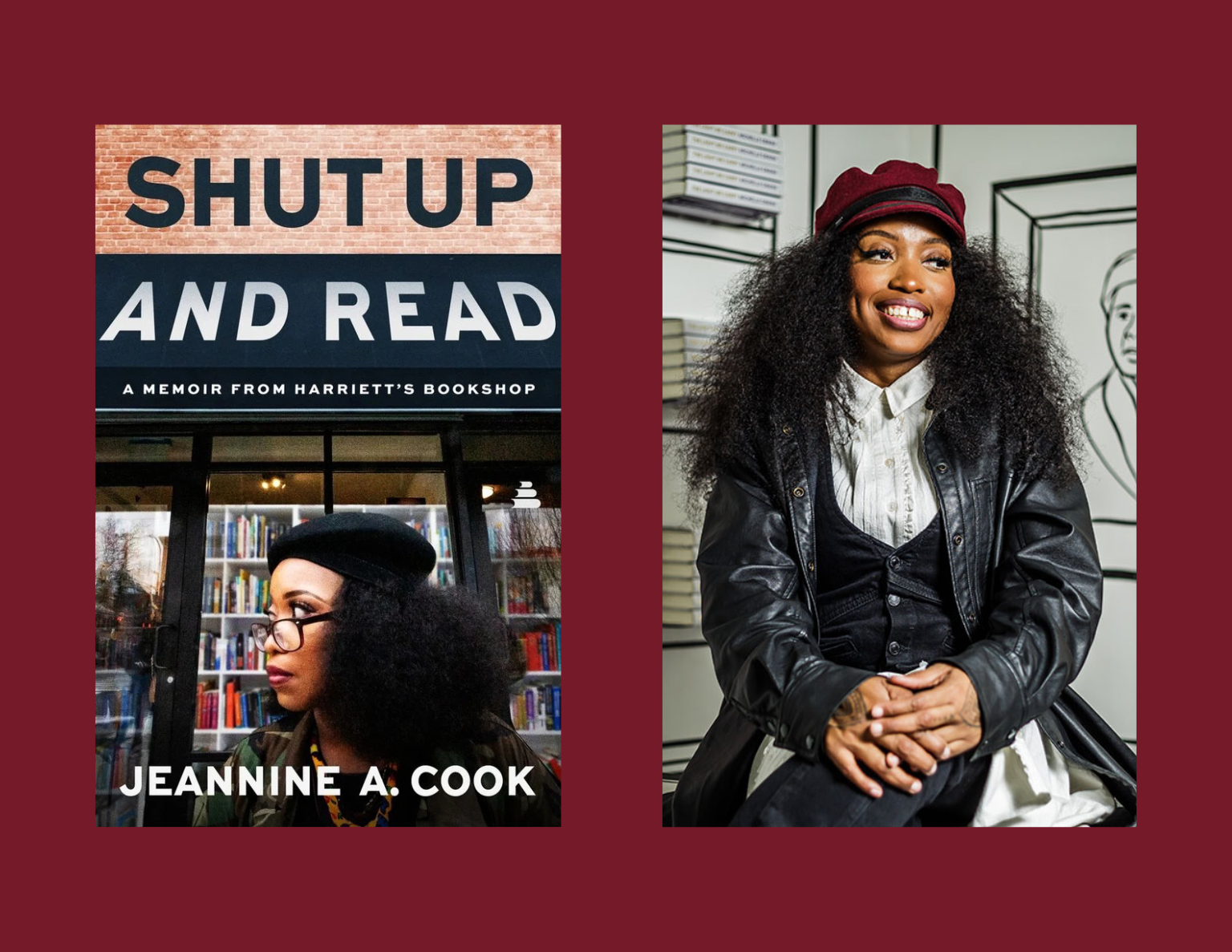
Jeannine A. Cook is an author, independent bookshop owner, and multidisciplinary artist based in Philadelphia. Her debut novel, It’s Me They Follow, was published in September of 2025, followed by her new memoir, Shut Up and Read, in March of 2026. She is a Drexel MFA alumnus and has had work published or reviewed by Publishers Weekly, Book Riot, Essence, BET, Cleaver Magazine, the Philadelphia Inquirer, and the Washington Informer, among other outlets.
Ronan Brinkley: Who were some of your inspirations when writing Shut Up and Read?
Jeannine A. Cook: There are certain people who kind of shake me. Octavia Butler, and Toni Morrison, and Zora Neale Hurston, and Alice Walker. If you think of them as my literary grandmothers, you’ll always see their imprint in my genealogy, so to say. They’re my foundational folk. More recently, I’ve been inspired by meeting Sonia Sanchez, and some Philadelphia voices, like Sadeqa Johnson. Having some of those women in my immediate life, people who I actually know, they also have an effect on my writing, I would say.
RB: Do you have any advice for new writers?
JC: When I got to Drexel, I came in thinking and feeling like I wasn’t a writer. Who was I to be calling myself a writer, you know? That felt like such a high-ranking title in my mind. I remember asking the director of the Drexel Creative Writing program, how does one finally decide that they are a writer? And she says, you know, writers do writerly things, right? You attend readings, you read books, you speak to authors, you write! You spend time in that universe and really kind of submerge yourself in it and in doing so you experience the life of a writer; you experience yourself as a writer. That would be my advice: to really submerge yourself in the writing universe, and try genre hopping, and try being in communities that are not like what you would consider to be your first language. So, if you’re a poet, maybe spend some time with screenwriters, if you’re an essayist maybe spend some time with some playwrights, just to expand your own pen, and your vocabulary as a writer.
RB: Speaking of genre hopping, was there anything that swayed you to move into nonfiction writing or was that something you were already doing?
JC: Creative nonfiction I would say would be my first language. When I was at Drexel, I was exposed to a lot of other types of writing, and the program at the time was really focused on narrative, which I thought was hard for me. I was like, oh I don’t know, I can’t do this, but it turned out that my first book deal was actually a fiction book, so I published fiction first.
RB: Could you say more about how your time at Drexel shaped you as a writer?
JC: I think Drexel gave me confidence; it gave me community. Being in the Creative Writing MFA Program just gave me the rigor, because I think sometimes when you’re on your own and you’re left to your own devices, you might not push yourself as hard as when you’re in a class, or when you have a professor, or when you have these deadlines, or when you have these courses that are a little out of your comfort zone. All of that, I believe, helped me to blossom.
RB: You have Harriet’s in Fishtown, Ida’s in New Jersey, and then you have an installation in Paris as well. I was wondering how you choose your locations and what they mean to you?
JC: It’s kind of a dance. In some ways, I feel like they choose me. I wanted to be down in Mantua/Belmont, that’s where I thought I would start. I used to teach down there, I used to do a lot of community work down there, I lived down there, so I thought, OK definitely I want to be down the bottom. It’s historical. I felt like I really needed it. But I didn’t get any positive feedback from landlords at that time, and it was someone in Fishtown who said yes.
With Ida’s, I got a chance to be in Collinswood and Haddon Township, and now we’re doing some work in Camden with Camden Fireworks. So, I’ve been able to be in several areas in South Jersey, and Camden County. I’ve been able to build a lot of community down there that I wouldn’t have been able to be a part of if I didn’t have Ida’s. Ida’s has been inside of a train station, it’s been in the town square, right now it’s at a fire station. You never really know where that’s gonna take you. Josephine’s, same thing. I allow myself to be as guided as I am.
RB: What is your book curation and buying process like? Is it different per store?
JC: I’ve changed over time. Right now, I’m in a season of not necessarily trying to chase every new book that comes out. I’ve felt more comfortable working off of themes and not feeling so heavily attached to whatever is new. I think that there’s so many books that get published every year, every month, and it becomes this crazy consumer-based thing when you’re trying to chase every new title and every new author. Recently, I’ve felt more comfortable thinking, ‘What kind of theme would I like to study? What kind of theme would I like to share with the community? What kind of conversation would I like to spark?’ And then getting books based on that. Each of the shops will have their own thing based on whatever it is that I’m working through.
RB: Are there any themes specifically that are interesting you right now?
JC: Well, Shut Up and Read came out, and that was kind of like the featured book. A lot of the titles connect back to Shut Up and Read, so you have a lot of things around stillness, and quiet, and meditation, and ritual, and tea.
RB: Do you have five all-time book recommendations?
JC: I usually don’t do it that way. During COVID I had a friend, Dr. Hug, and Dr. Hug came to ask, ‘Jeannine can you just give me five books, any five.’ And I was like, ‘Dr. Hug, what are you talking about? If you thought of books like medicine, if I came in your emergency room and was just like ‘Dr. Hug just give me five pills, any pills,’ you’d look at me like ‘Jeannine what are you talking about?’ You wouldn’t just prescribe me out of the blue without any kind of understanding of my symptoms or my desire.’ And so, I try not to do it either, because I’d much rather craft something for somebody according to what they might be needing, like medicine in a way, if and when that’s possible.
RB: Is there anything else you’d like to add about the book, your bookshops, anything?
JC: I’m just really thankful. I’m really thankful that we’ve made it this far. I’m thankful for all the lessons I’ve learned. I’m thankful for the support we’ve been able to garner. I’m interested in where it takes me. Every step of my life is preparing me for the next step. I can see how being a teacher all those years, especially with young people who had dropped out of high school, working with that specific group, how that really prepared me for Harriet’s. And now that Harriet’s and the other bookshops exist, I’m interested in like, what could this possibly be preparing me for? What could come after this? So, I’m interested in how this is a steppingstone toward something else, and something new, and something different but still interconnected in a way. I’m just thankful for the experience of it all.
You can learn more about Jeannine A. Cook and her work here.

Ronan Brinkley is a Philadelphia based writer and Drexel alumnus who completed their BA in English. They enjoy horror movies, and long walks on the beach. In their free time, they like writing poetry, reviewing books, and critiquing shoddy films. They dream of someday having a mug cabinet.