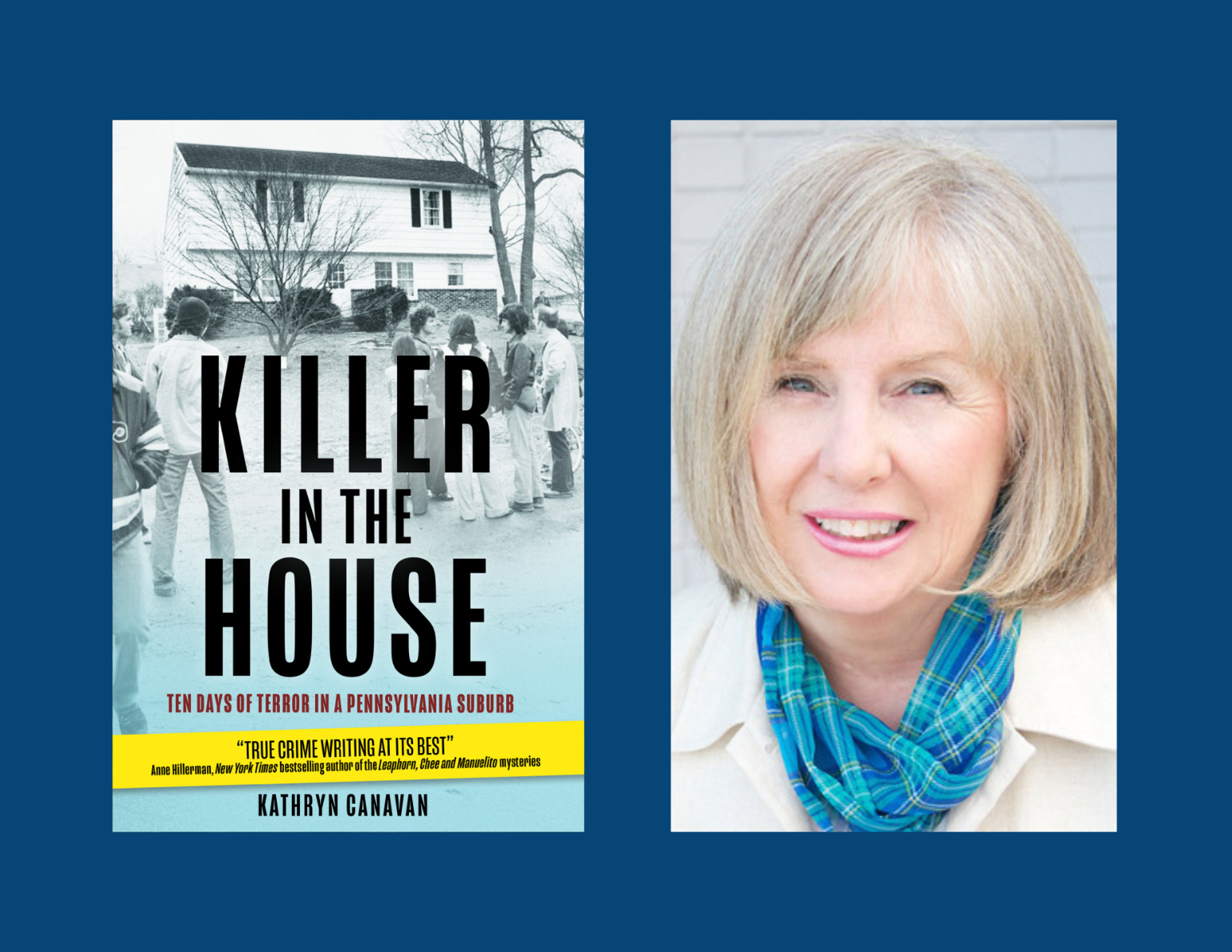
Kathryn Canavan started her writing career as a news reporter. She combines her journalistic instincts with historical research for her true crime books. Canavan’s latest release, Killer in the House: Ten Days of Terror in a Pennsylvania Suburb, brings her career full circle to a case she originally covered in 1976, when five members of the Abt family, and a family friend, were murdered in their home. Her book is a gripping, minute-by-minute recount of one of Bucks County’s most notorious killings, written 50 years later by a journalist who was at the scene of the crime shortly after the killer fled.
Katharine Le: Can you talk about your experience as a reporter working for the newspaper during the 1970s, especially as a young woman covering crime investigations?
Kathryn Canavan: When I was 21 to 25 years old, I think a lot of politicians I interviewed were kind of dismissive of me, or at least they weren’t as careful and defensive as they might have been with my pushier male colleagues. Later, I think that was kind of an advantage because they really were speaking freely. There were challenges that male reporters didn’t face, but you would mostly have to deal with offstage. You’d hear some of the men in the composing room making comments about what you were wearing. But as you get older, men tend to treat you more professionally. There were also more women entering the hard news side of journalism as time went on, which made things a little better.
KL: How did you manage the emotional weight of the Abt murders both when they happened and in revisiting the case for this book?
KC: When I was preparing for Killer in the House, I interviewed one of the detectives and asked, ‘You know, back then they didn’t have these police psychologists you see on Law and Order. How did you just keep going?’ They were all working very long hours and it was a 10-day search for the killer. They had no idea if he lived next door or if he got away on I-95. The officer said, ‘Well, back then, you just did the job. You just kept doing the job.’ And I realized that’s what I did. When I was writing about the case as it was happening, the emotions didn’t really hit me until after the arrest and the trial.
KL: How do you balance the storytelling aspect of writing while still maintaining respect for everybody who was involved with the case?
KC: I think it’s really important that your first job is to be objective and to tell the truth, but I’ve seen reporters who have really obscured the facts because they side with one group or another. I guess it’s hard to be straight-down-the-middle objective, but your job is to be objective. First of all, you must make sure that your story is true and you’ve interviewed as many sides as you can. Beyond that, I have tried to be sensitive to the people I’ve interviewed. In one case with the book, there was another very sensational news story happening close to the Abt house, but I didn’t see where including it would be helpful in any way, except for the fact that it’s a sensational story that people would read. While it would have been a great diversion, you need to consider how it didn’t happen in the house, and it didn’t happen to a member of the Abt family. It wouldn’t have helped anyone, and it would hurt the other family. I believe that you must balance what is essential and what is not.
KL: Can you talk about how you transitioned from journalism to writing true crime books?
KC: One of the things that enabled me to write this story was being a reporter who had to write every day. What I love about journalism is when you go to work in the morning, you don’t have any clue what you’re going to be doing that day. I’ve interviewed a woman who had a boa constrictor as a pet, a woman who was a self-proclaimed witch…and then you have serious stories like bank robberies, and what that does for you is allow you to write every single day no matter what. Journalism caused me to become an author. I had left the full-time newsroom to care for my mother. When she died 18 years later, I tried to get back into the newsroom, but the job market was rapidly shrinking. I couldn’t return to where I was when I had left, so I started freelancing for magazines. One article I wrote was for the AARP, which led me to discover the topic of my first book. My books have all been kind of giant news stories about Lincoln’s death, crime in Philadelphia through the centuries, and this one about two totally unconnected multiple murders that happened on the same day and during the same hours and just four miles apart. I didn’t transition to novels where you need some imagination. I just found a story that I thought would make a book and went after it.
KL: What was the research process like when you were closing the gap between the time you started writing this book in 2023 and your original notes from 1976?
KC: When I started to write Killer in the House, I went back to the house where the Abts were killed. During my first visit to the street where it happened, I found the police officer who found the bodies. He was kind enough to make some phone calls for me. Within a few hours I had spoken with the only living survivor and a man who helped me on the raucous night of the arrest when guns were flying. When I realized I had connected with three of the key people I needed before lunchtime, I thought it was kismet – I knew the book was meant to be. Additionally, I searched through court transcripts, school records, prison records, two newspaper databases, the autopsy reports, and the killer’s own eidetic confession. An official helped me find two boxes of long-lost police notes. I really don’t think I missed any articles written in Bucks County, Philadelphia, or Cherry Hill. The same officer I spoke to on my first visit to the street was also exceptionally kind and connected me with other officers who were living from Florida to California. I never would have found them on my own. The police, attorneys, and neighbors all had great stories. Each one was like a building block.
KL: In revisiting the motives of the killer and the specific environment of this small town in Bucks County, were there any parallels or lessons that stood out to you today?
KC: I mean, the killer’s life was just so sad. People who were young parents in Trevose at the time, and they told me unprompted things like, ‘I always raised my kids to be kind to everyone because you never know.’ It just shook me that at least three parents said that. You realize how this community was affected, not just by the horror of the killings, but by that thought. You know, there’s that quote that’s attributed to Philo of Alexandria. It reads, “Be kind, for everyone you meet is fighting a great battle,” where we really don’t know what’s going on in someone else’s life. One of the things that I learned is that you can’t assume anything. You really must ask to follow up questions because we all have such different experiences.
KL: Do you have any advice for young writers wanting to become published authors or pursue journalism?
KC: I think the key is hard work. You can only write a story if you have all the facts. If you gloss over half of them, your story’s just not going to be interesting because people will say, ‘Hey, there’s a hole here.’ And if you go in a different direction and do investigative reporting, you can fix things. You can influence the world, which you can’t do in every job. Remember that your first obligation is to be objective and to tell the truth. Not to sympathize with one side or another, but to be down the middle. And that doesn’t mean you can’t be sensitive to people. It just means you can’t lie for people. That is your best bet as a writer and to have a complete story.
You can learn more about Kathryn Canavan and Killer in the House: Ten Days of Terror in a Pennsylvania Suburb on her website.

Katharine is a third-year student at the Drexel University pursuing a B.S. double-majoring in Marketing and Business Analytics. She loves reading fantasy books and dreams of working within literary publishing after graduation. Aside from curling up under a pile of blankets, you can find her journaling, rewatching her favorite TV shows, and attempting to propagate her houseplants.