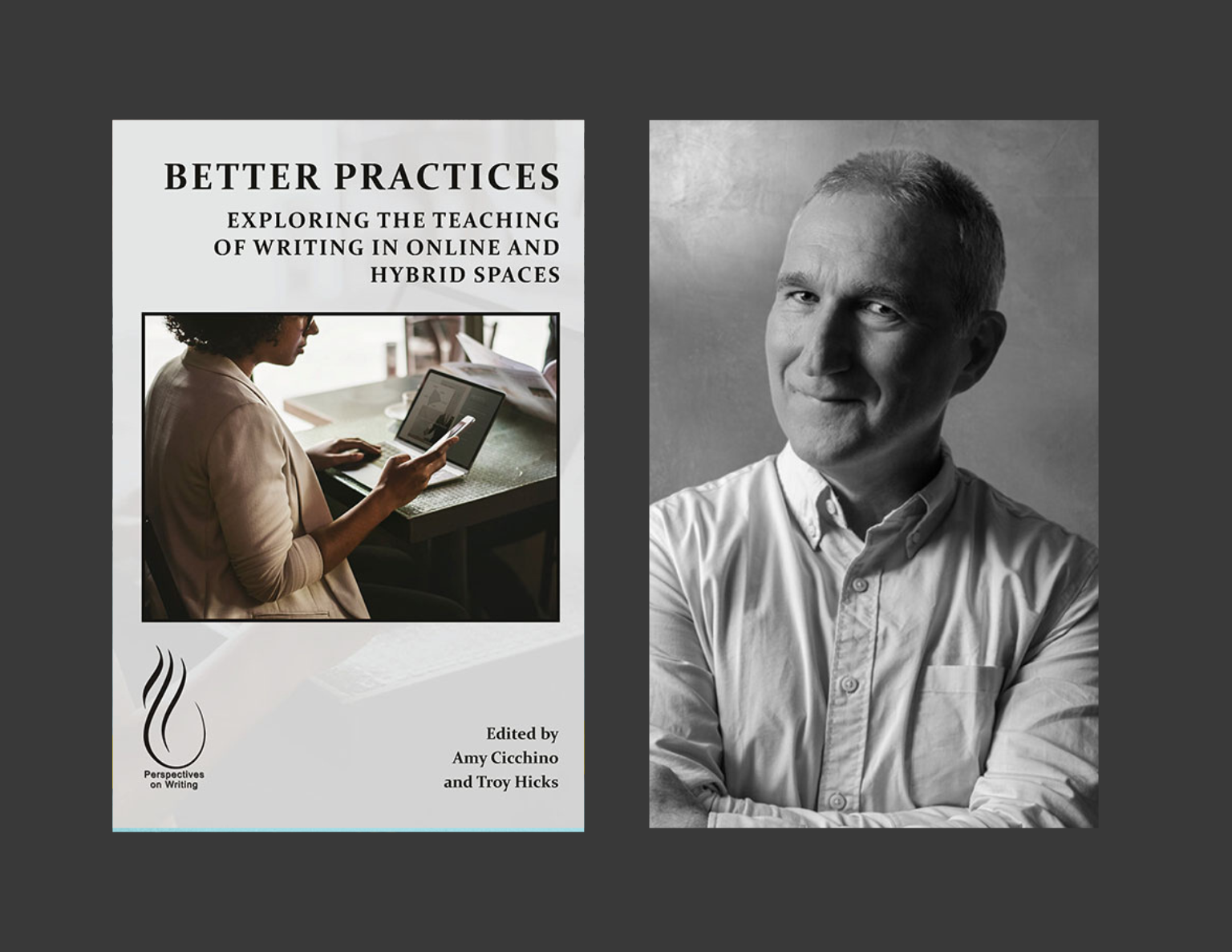
Scott Warnock is Associate Dean of Undergraduate Education in the College of Arts & Sciences at Drexel University. His professional interests include technology and writing instruction, especially online learning. He has authored or co-authored five books and numerous chapters and articles and has written the blog Online Writing Teacher since 2005. He was President of the Global Society of Online Literacy Educators from 2018 to 2020.
Khristina Cabrera: What first drew you to your professional interests in teaching with technology, online writing instruction, and navigating AI use in the classroom?
Scott Warnock: I was a freelance technical science writer and journalist early in my career, with an interest in teaching business and tech writing. I built up some expertise in that area at Penn State, and I also became increasingly interested in using technology to teach. Then a position opened at Drexel University, and I took it to work in the first-year writing program. Initially, the courses were going to be all online, mainly because of classroom space pressure, but what worked instead was hybrid learning, which still makes up two-thirds of the program. I just became really interested in the prospects of online courses for writing.
AI came in a little later. Now in my career, I have a lot of expertise in teaching with technology. I’ve been involved with several organizations over the years, even founding an international organization focused on online literacy instruction, which reflects how strongly I’ve always embraced new technologies. I’m not scared of AI, but navigating AI usage in classrooms has just become part of writing instruction now, and I will say, it’s become more complicated.
KC: Have you experienced much opposition with you incorporating AI and technology into your writing courses, if any?
SW: I don’t think the world’s coming to an end because of AI. I know a lot of educators in both K-12 and higher education are hoping to get out, because they think this is it, and they think that what they have done doesn’t work anymore. In some cases, they just don’t want to deal with it in English courses, where a primary writing medium has been the paper/essay assignment, which is definitely under threat from AI. With some other colleagues in my department and other educators across the country, however, I’ve done faculty development for writing across the curriculum, which has always involved really good assignment creation.
This is a much more sophisticated problem when we think of plagiarism, authenticity, and cheating. Problems with cheating have existed for decades. When I was in college, students could go to a warehouse up in North Jersey and pay for a pre-written paper. Now, AI has changed the scene because it can spit out a paper very quickly, but if you’re asking students right now, for instance, to write me a paper about Hamlet’s indecision, that paper has been assigned for a long time and is an easy paper to cheat on.
Instead, I have a positive feeling about assignment creation in writing studies, composition, and rhetoric. This has fallen into our wheelhouse, because it’s mainly process-oriented, reflective, and informal writing. I think that we have to help faculty and help ourselves lean into this kind of writing, while also shedding the idea that students need to give us this perfect paper with perfect margins and a little staple in the corner. Embrace sloppy drafts. Stop expecting students to give you the perfect draft, because that’s where you’re getting these inauthentic things.
I do feel for my faculty colleagues. I get it, because as a teacher, you’re thinking, if I have one hundred students, how am I going to check all of these? People are going back to blue books, all-in-class writing, and the oral exam, which I understand, because those are attempts to get around AI-based cheating. There’ve been AI issues with really egregious inauthenticity, where a student puts a prompt in and then hands in exactly what was produced. It’s a problem that’s not solved yet, but I definitely think there are ways that you can assign smart assignments and have students working together, showing their work. That can help you in your use of writing in the classroom. There have been great conversations with people on both ends of the continuum about this within Drexel’s First-Year Writing Program.
KC: Is it possible for AI to replace writers?
SW: It depends on who you ask. As for me, someone once said that AI can replace writing, but AI can’t replace writers fully, and I agree with that.
One thing we should be thinking about as we move into the future of AI is: in what uses is this tool effective, and in what places do we need human intervention Also, in a more nuanced way, what does that intervention look like? When should humans be the mediators of what AI creates? For example, when a student uses AI to look for sources, I don’t have a problem with that. The problem is when a student picks up hallucinated sources and just drops them in. As for myself, in the past, I’ve refused to let Outlook autocomplete my sentences. I’ve changed my stance on that now, not only because it saves me keystrokes, but I also write a lot of similar emails for my job. It’s an ergonomic thing.
Overall, I think that we still have to teach students when to use human mediation to make the most of these tools.
KC: AI and technology are constantly evolving. How do you stay up to date with the latest information, and how do you translate this into your teaching and writing processes?
SW: It’s difficult to fully keep up, there’s no doubt about it. What’s been great, however, is that I’ve been able to utilize my own vast file of materials about AI in my writing courses.
I’ve been co-teaching a course called Writing For and About AI this term with Dan Driscoll. The two of us, alongside our students, are appreciating this opportunity to study all these current issues in real time. We’re using readings that were published two weeks ago. We’re talking about having this as an ongoing course, because AI is such a hot topic that there are so many moving targets, including usage in the classroom, possibilities, creativity, politics, and the environmental impact of these tools.
I’m not the world expert on using AI, but this course aims to help students think in terms of rhetoric about how they write for and about the machine.
KC: What is an important takeaway that you would want educators to know about AI in the classroom?
SW: The big takeaway is that the world is already using these tools all the time. AI is embedded in so many things nowadays, and there is so much business and media hype surrounding it. Billions of dollars have been poured into the industry. For teachers, this means that students are inevitably going to be using these tools. If you want to go back to blue books and do oral examinations, that’s fine, but I do think it’s important to recognize that students are going to be using AI in their careers and their fields. Going out into the world without any experience thinking about AI would be a real disservice. We should help students use the tools in productive ways. For example, include meta-reflections at the end about how they used AI in assignments, or guide students when thinking more in-depth about their writing process.
KC: What are Process Narration Videos, and how have they shaped your approach to writing instruction and the use of technology in writing spaces?
SW: I was speaking with one of my very smart students about her writing process, because she claimed that she just writes from start to finish before submitting her paper. She came back to my office about thirty minutes later, and she had created a video of her process while writing a paper for my class. I noticed that this video didn’t use complicated technology. She simply pulled up Google Docs (but Word, or any word processing software would do), and viewed her former versions of her paper, which are built into these applications, and then she narrated herself walking through her tracked changes and reflecting on her own revision and writing.
Could you use AI to cheat on this? You would have to work hard to do that, because this shows every tracked change in a document. It’s a great way of demonstrating authenticity in student writing.
I thought this would be a great concept on a larger scale. We ended up submitting a proposal on Process Narration Videos to The National Council of Teachers of English (NCTE) Conference. This was recently accepted, so we’ll be presenting a paper at the NCTE Conference in Philly next November!
KC: Is it disheartening to be an English professor in the time of AI, and what keeps you motivated and gives you hope to continue teaching students?
SW: I’m not disheartened by any of it. The students are the center of this universe for me, and they continue to bring new ideas and perspectives. They’re really grappling with this productively in the corners of the university in which I teach, and I find them incredibly engaged. I want to help facilitate conversations about these topics so that they’re prepared not just for the workforce, but the future in which AI is going to play a major role.
By the way, this is coming from somebody who did a lot of asynchronous teaching. My model there isn’t as effective anymore, because AI is a big problem in discussion board conversations, so I’m thinking now, what can I do differently to continue to give students a good educational experience? I don’t want to think, how can I prevent them from cheating, because I think once you get into that deficit kind of approach, then it can be more frustrating.
I think that there are a lot of possibilities here. It’s not going anywhere, for sure, and we should find ways to work with it and even be excited.
You can read Scott Warnock’s latest work, a co-authorship of the Foreward in Better Practices: Exploring the Teaching of Writing in Online and Hybrid Spaces, here.

Khristina L. Cabrera (she/her) is pursuing her bachelor’s in English and master’s in Strategic and Digital Communication at Drexel University (’28), with a minor in Linguistics. Her work has previously appeared in The 33rd, Cathartic Youth Literary Magazine (Editor’s Choice Piece), National Flash Fiction Day Youth Competition (longlisted), and Love Letters Magazine, among others.